Learn About Emma Nutt
Read a reliable account of Emma Nutt’s first day as a telephone operator and learn how her employment influenced the rapidly developing communications industry.
Emma M. Nutt Day is observed on September 1 to honor the pioneering woman who became the world’s first female telephone operator on this date in 1878.
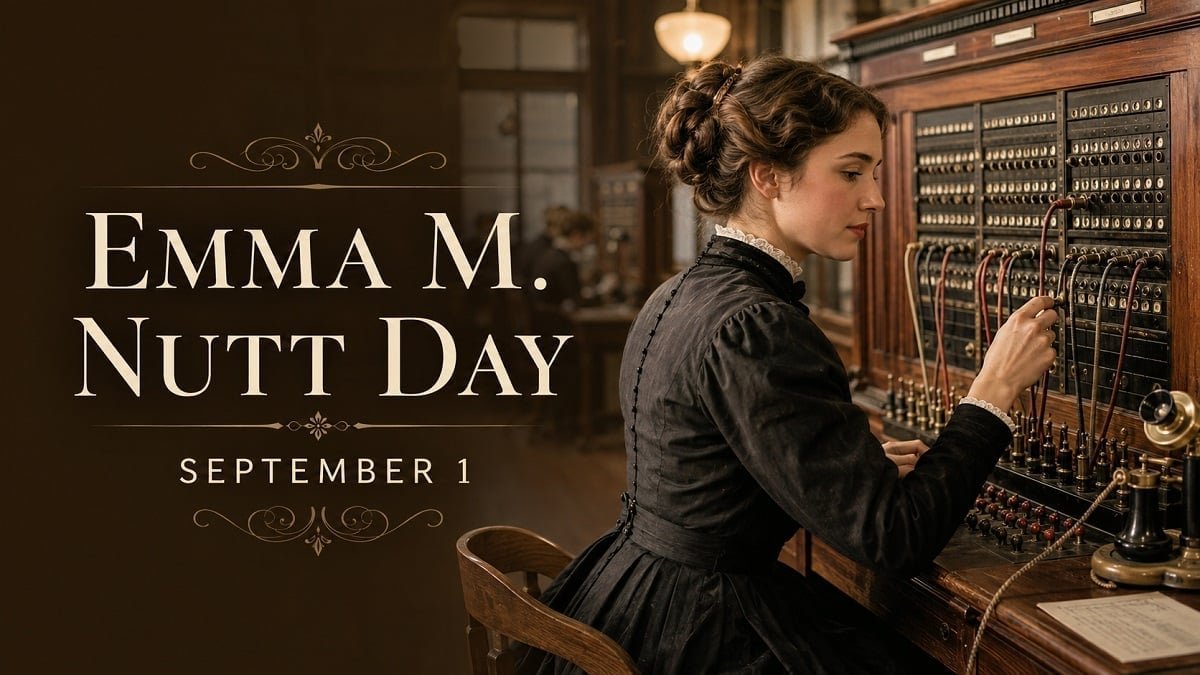
Emma M. Nutt Day is observed every September 1 in recognition of Emma Nutt, who made communications history when she became the world’s first female telephone operator in Boston on September 1, 1878.
Her appointment marked an important change in the rapidly developing telephone industry. Telephone exchanges initially employed boys and young men to connect calls manually, but companies soon began hiring women. Emma’s successful entry into the profession helped open a new area of employment for women that would become strongly associated with female workers for generations.
The day provides an opportunity to learn about early telephone technology, recognize the demanding work of switchboard operators and remember a woman whose first day at work became an important milestone in both communications and employment history.
Origins, development, and the events that shaped this observance.
The telephone was still a remarkably new technology when Emma Nutt entered the profession. Early telephone customers could not simply dial another person directly. Instead, they contacted a telephone exchange, where an operator manually connected the caller to the requested line through a switchboard.
During the first months of commercial telephone service, operators were primarily boys and young men, many of whom had experience in telegraph offices. Telephone companies, however, received complaints about impatience, practical jokes and inappropriate behavior from some of these early operators.
On September 1, 1878, Emma Nutt began working at the Edwin Holmes Telephone Dispatch Company in Boston. Alexander Graham Bell recruited her from a telegraph office, making her the first woman known to work professionally as a telephone operator.
Her first day proved successful. Emma was noted for her patience and professional manner, and her sister Stella Nutt joined the same company only a few hours later, becoming the second female telephone operator.
The experiment helped transform the telephone industry. Companies increasingly employed women as operators, and within a relatively short period switchboard work became a major source of paid employment for women. The Federal Reserve Bank of Richmond notes that female operators were valued by employers for qualities such as patience and reliability, although their labor was also cheaper than that of men.
Emma herself remained in telephone work for at least 33 years, according to historical accounts cited by Smithsonian Magazine. Her pioneering position therefore developed into a long career rather than a brief historical first.
Emma M. Nutt Day is now observed on September 1 because that is the anniversary of her historic first day in 1878. Major observance calendars recognize the date, but the sources reviewed do not provide a reliably documented creator or original founding year for the commemorative day.
Practical ways to observe the day thoughtfully and meaningfully.
Emma M. Nutt Day offers a useful opportunity to explore the beginnings of telecommunications, women’s employment history and the enormous technological changes that have occurred since manually operated telephone exchanges. The day can be observed through educational, historical and communication-focused activities.
Read a reliable account of Emma Nutt’s first day as a telephone operator and learn how her employment influenced the rapidly developing communications industry.
Visit a telecommunications museum or explore a reputable online museum collection featuring early switchboards. Compare the manual process of connecting calls with today’s automated communication systems.
Use the day to learn about other women who worked as telephone operators, engineers, inventors and communications professionals after Emma helped open the profession to women.
Trace communication technology from manual switchboards and rotary telephones to digital networks and smartphones. It provides an engaging way to see how dramatically telecommunications has changed.
Mark a day rooted in telephone history by making a real voice call to a friend or relative you have not spoken with recently. It is a simple tribute to the technology that connected generations.
Create a short school presentation, workplace post or social media feature explaining what happened on September 1, 1878 and why Emma Nutt holds a place in communications history.
Memorable details and useful context connected with Emma M. Nutt Day.
Emma Nutt entered telecommunications when the industry itself was only beginning to develop. Her first day became part of a much larger transformation in how people worked and communicated.
Emma became the world’s first female telephone operator on September 1, 1878, while working in Boston.
Alexander Graham Bell personally recruited Emma from her previous work at a telegraph office.
Emma’s sister Stella began working at the same telephone company later that day, becoming the second female operator.
Historical accounts report that Emma initially worked a 54-hour week for $10 per month.
Smithsonian reports that Emma remained in the telephone industry for at least 33 years.
Early telephone users relied on operators to physically connect their calls through manual switchboards.
Early operators could provide information, take messages and even help callers contact doctors or police during emergencies.
Important moments that shaped the day and its place in the calendar.
Telephone exchanges are still a new development, with operators manually connecting customers through switchboards rather than callers dialing numbers themselves.
Emma Nutt begins work at the Edwin Holmes Telephone Dispatch Company in Boston and becomes the world’s first female telephone operator.
Only hours after Emma begins work, her sister Stella joins the same company and becomes the second female telephone operator.
Telephone companies increasingly replace male operators with women, turning switchboard operation into an important new occupation for female workers.
Telephone operators in New England participate in a major labor strike over working conditions and compensation, eventually securing a wage increase.
Following an employment discrimination complaint, AT&T agrees to open its jobs to both men and women rather than maintaining heavily gendered job categories.
September 1 is now observed annually as Emma M. Nutt Day, commemorating the anniversary of her historic first day as a telephone operator.
Helpful answers about the date, meaning, and observance.
Emma M. Nutt Day is observed annually on September 1, the anniversary of Emma Nutt’s first day working as a telephone operator in 1878.
Emma Nutt was an American telecommunications pioneer who became the world’s first female telephone operator in Boston on September 1, 1878.
September 1 commemorates the date in 1878 when Emma began working at the Edwin Holmes Telephone Dispatch Company and made telecommunications history.
Emma Nutt was recruited by Alexander Graham Bell, who hired her away from a telegraph office to work as a telephone operator.
No. Male telephone operators worked before her. Emma Nutt’s distinction is that she became the first female telephone operator.
Yes. Her sister Stella Nutt began working at the same Boston telephone company a few hours after Emma and became the second female telephone operator.
Historical accounts cited by Smithsonian indicate that Emma worked in the telephone industry for at least 33 years.
Operators manually connected calls using switchboards. They could also provide information, relay messages and assist customers with other communication needs.
Her successful appointment helped encourage telephone companies to employ more women, contributing to the rapid growth of telephone operating as a major occupation for women.
A reliable founder or original founding year for the modern observance is not documented in the sources reviewed. What is firmly established is that September 1 commemorates Emma’s historic first day in 1878.
 Featured
Ginger Cat Appreciation Day is observed every September 1 to celebrate orange and ginger cats while encouraging appreciation, responsible pet care, adoption and support for animal rescue.
Read the story Featured
Building and Code Staff Appreciation Day is observed every September 1 in the United States to recognize the professionals who help keep buildings, infrastructure and communities safe.
Read the story