Spend Extra Time With Your Cat
Give your ginger companion some additional attention through play, grooming or quiet time together. Choose activities your cat already enjoys rather than forcing interaction.
Ginger Cat Appreciation Day is observed every September 1 to celebrate orange and ginger cats while encouraging appreciation, responsible pet care, adoption and support for animal rescue.
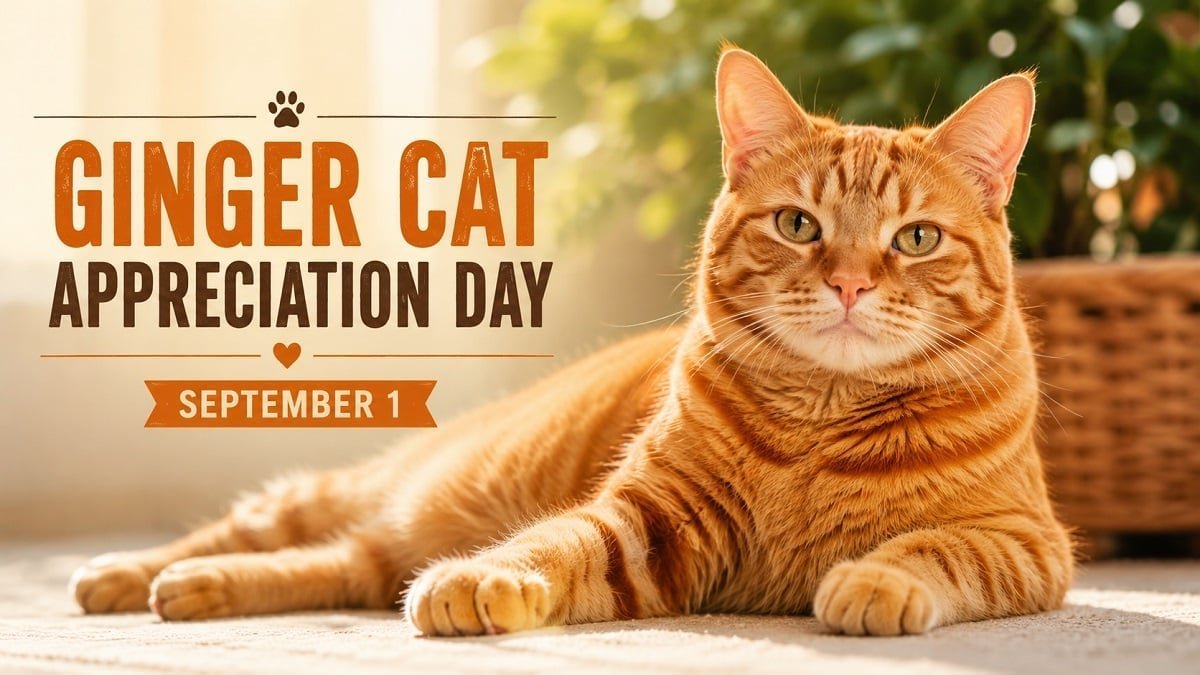
Ginger Cat Appreciation Day is observed annually on September 1, giving cat lovers an opportunity to celebrate ginger, orange and red-coated cats while also drawing attention to animal rescue and adoption. The observance was created in memory of a ginger cat named Doobert and has since become recognized by pet lovers and observance calendars internationally.
Ginger describes a coat color rather than a specific cat breed. The Cat Fanciers’ Association notes that coat colors and patterns do not determine a cat’s breed, and orange-colored cats can occur among different pedigreed breeds as well as mixed-breed domestic cats.
Beyond simply admiring their striking coats, the day has a meaningful connection to animal welfare. Its founder, Chris Roy, named his animal-rescue technology platform Doobert after the ginger cat who had been his companion for 17 years. Today, the occasion offers a fitting reason to appreciate cats, support shelters and learn more about responsible animal care.
Origins, development, and the events that shaped this observance.
The story behind Ginger Cat Appreciation Day centers on Chris Roy and his ginger cat, Doobert. Roy took in Doobert as a stray kitten, and the cat remained an important part of his life for 17 years. UPI reports that after Doobert died in 2014, Roy established Ginger Cat Appreciation Day in his memory.
Doobert’s influence extended beyond the commemorative day. Roy was also involved in animal rescue and used his technology experience to develop a system that could help coordinate rescue work. According to Doobert’s official history, the Doobert.com platform launched in May 2014 and was designed to help animal shelters, rescue organizations and volunteers work together more effectively.
Roy chose September 1 for Ginger Cat Appreciation Day, creating an annual occasion that celebrates ginger cats while preserving the memory of the companion who influenced his animal-welfare work. Current observance sources consistently list September 1 as the recurring date.
The day has also become an opportunity to learn about the science behind orange cats. Scientists had known for decades that orange coloration was linked to the X chromosome, but the exact genetic mechanism remained unresolved. A 2009 genetic study narrowed the orange locus to a particular region of the feline X chromosome.
A major breakthrough arrived in 2025, when Stanford Medicine researchers identified a small DNA deletion associated with increased activity of the ARHGAP36 gene in pigment cells. The discovery helped explain both the orange coloration and why fully orange cats are more commonly male than female.
Ginger Cat Appreciation Day therefore combines a personal memorial, animal-welfare message and celebration of one of the most recognizable coat colors found in domestic cats.
Practical ways to observe the day thoughtfully and meaningfully.
Ginger Cat Appreciation Day can be celebrated whether you live with an orange cat or simply enjoy animals. The most meaningful activities combine appreciation with responsible care and support for cats that still need safe, permanent homes.
Give your ginger companion some additional attention through play, grooming or quiet time together. Choose activities your cat already enjoys rather than forcing interaction.
Donate food, bedding, funds or other requested supplies to a reputable shelter or rescue organization. You can also ask whether volunteers or foster homes are currently needed.
If you are genuinely ready for the long-term responsibility of caring for a cat, visit a reputable shelter and meet cats waiting for homes. Choose based on individual temperament and suitability rather than coat colour alone.
Use the day to explore why orange coloration is linked to the X chromosome and how modern genetic research finally identified the molecular mechanism involved.
Post a favourite photograph or story about a ginger cat that has been part of your life. You can also use the opportunity to highlight responsible adoption and animal-rescue organizations.
Because Ginger Cat Appreciation Day began as a memorial to Doobert, the occasion can also be used to remember a cat or other companion animal whose life left a lasting impact on you.
Memorable details and useful context connected with Ginger Cat Appreciation Day.
Ginger cats are visually distinctive, but some of the most interesting things about them are found in their genetics. Here are several short, verified facts.
“Ginger” describes coat coloration. Cats with orange colouring can belong to different breeds or be mixed-breed domestic cats.
Scientists have long known that the genetic trait responsible for orange coloration is sex-linked and located on the feline X chromosome.
Male cats need only one copy of the sex-linked orange variant, while females generally need it on both X chromosomes to be fully orange.
Although less common, fully orange female cats are genetically possible when they inherit the orange variant on both X chromosomes.
Researchers identified a small DNA deletion that increases ARHGAP36 activity in pigment cells of orange cats.
Stanford researchers note that historic artwork shows cats carrying orange-related coloration as far back as the 12th century.
Orange cats have many popular personality stereotypes, but researchers say there are few scientific studies connecting orange coloration with personality.
Important moments that shaped the day and its place in the calendar.
Chris Roy takes in a ginger stray who becomes known as Doobert. The cat remains his companion for 17 years and later inspires the name of Roy’s animal-rescue platform.
Researchers map the sex-linked orange locus to a region on the domestic cat’s X chromosome, bringing scientists closer to understanding orange coat genetics.
Roy’s animal-rescue technology platform launches to help shelters, rescue organizations and volunteers coordinate their work.
Following Doobert’s death, Chris Roy establishes Ginger Cat Appreciation Day in memory of his longtime ginger companion.
September 1 becomes the recurring date for celebrating ginger cats and encouraging appreciation for rescue animals.
Stanford-led researchers identify the genetic change linked to orange coloration, solving a question that had challenged feline geneticists for decades.
Helpful answers about the date, meaning, and observance.
Ginger Cat Appreciation Day is observed every year on September 1.
It is an annual observance celebrating ginger and orange cats while also encouraging appreciation for companion animals and support for animal rescue.
Chris Roy founded Ginger Cat Appreciation Day in 2014 in memory of his longtime ginger cat, Doobert.
Roy created the observance after Doobert died in 2014. Doobert had been his companion for 17 years and also inspired the name of Roy’s animal-rescue platform.
September 1 is the annual date chosen by founder Chris Roy for the observance. Reliable sources confirm the date, although the sources reviewed do not document a separate historical reason for choosing that specific calendar day.
No. Ginger or orange describes a coat color, not a breed. Different breeds and mixed-breed domestic cats can have orange coloration.
The orange trait is carried on the X chromosome. A male normally has one X chromosome, so one copy can produce an orange coat, while a female generally needs the orange variant on both X chromosomes to be fully orange.
Yes. Female ginger cats exist, but they are less common because a fully orange female generally needs to inherit the sex-linked orange variant on both of her X chromosomes.
Research published in 2025 identified a small DNA deletion associated with increased activity of the ARHGAP36 gene in pigment cells, producing the characteristic orange coloration.
There is not enough scientific evidence to state that ginger cats have a particular personality because of their coat color. Stanford researchers note that few scientific studies have examined this supposed connection.
The observance originated in the United States, but modern calendar sources list Ginger Cat Appreciation Day internationally, and cat lovers in different countries recognize September 1.